Utilities
BiRefNet General
Removes the background from a photo and returns the subject on a transparent background, or as a black-and-white mask.
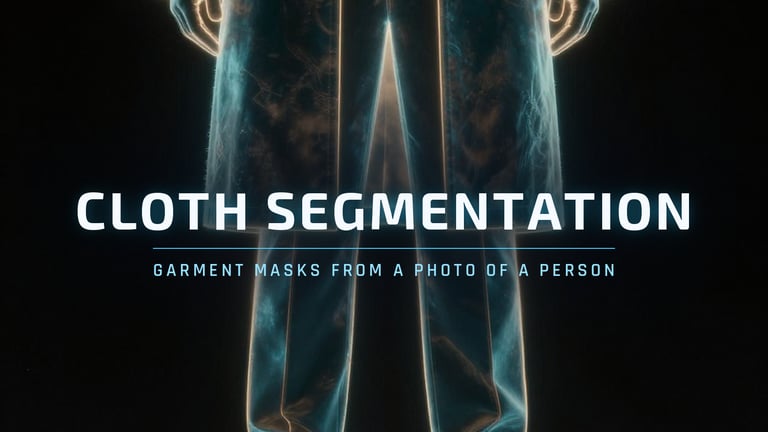
Fine-tunableCLOTH_SEGMENTATION_U2NETFinds the clothes a person wears in a photo and returns a mask for the upper body, the lower body and full-body garments such as dresses, each as a mask at the photo's size with its box and score.
Cloth segmentation by Levin Dabhi (levindabhi/cloth-segmentation), released under the MIT License, Copyright (c) 2021 Levin Dabhi; the network is U^2-Net by Xuebin Qin, Zichen Zhang, Chenyang Huang, Masood Dehghan, Osmar R. Zaiane and Martin Jagersand, released under the Apache License 2.0; the weights as exported by the rembg project (MIT License).
| Name | Type | Required | Default | Details |
|---|---|---|---|---|
image | file | Yes | — | The picture: PNG, JPEG or WebP, up to 20 MB and 40 megapixels. Masks have its size, scaled down to 2048 pixels on the longer side. 1–2048 characters · image/png, jpeg, webp |
Output. JSON: {"width", "height", "segments": [{"label", "score", "box", "mask"}]}, a segment for each of upper_body, lower_body and full_body found; box [x0, y0, x1, y1] in pixels, mask a COCO RLE {"size": [h, w], "counts"}.
Send your API key in the X-API-Key header. The run is asynchronous: submit it, then poll it until it finishes. Create an API key.
curl -X POST "https://api.kainguru.com/api/v1/executions?mlFlowId=CLOTH_SEGMENTATION_U2NET" \
  -H "X-API-Key: kg_your_api_key" \
  -H "Content-Type: application/json" \
  -d '{
  "input": {
    "image": "https://example.com/input.png"
  },
  "outputFormat": "json"
}'

# Poll until the execution reaches a terminal state
curl "https://api.kainguru.com/api/v1/executions/{executionId}" \
-H "X-API-Key: kg_your_api_key"from kainguru import KainguruClient
with KainguruClient(api_key="kg_your_api_key", base_url="https://api.kainguru.com/api") as client:
submitted = client.executions.execute(
"CLOTH_SEGMENTATION_U2NET",
{
"image": "https://example.com/input.png"
},
output_format="json",
)
result = client.executions.await_completion(submitted.id)
print(result.execution.output)You can fine-tune Cloth Segmentation U2-Net on your own data and run the tuned model through the same API. Dataset: One ZIP (at most 4 GB, no password) with 4 to 1000 pictures, a label map for each (a PNG whose pixel values are the classes 0 to 3) and a manifest.jsonl with one {"file", "mask"} line per pair. More rules: Good to know, in the README.
The steps are in the docs.
Price per image: 0.0874 credits ($0.000874). The price is shown again before every run; all prices are on the pricing page.
Removes the background from a photo and returns the subject on a transparent background, or as a black-and-white mask.
Fine-tunable
Splits a picture into its objects and regions, such as people, cars, sky and road, with a label and a mask for each one.
Fine-tunable
Removes the background from a photo with fine detail at hair and edges, and returns the subject on a transparent…
Fine-tunable
Click or draw a box on an object and get back a mask outlining it.
Fine-tunable
Outlines the things you name in a picture, such as "red car, person with a helmet", with a mask and a box for each one.
Fine-tunable
Estimates metric depth, surface normals and the camera's field of view from a single photo of any scene, indoors or out.
Fine-tunable